

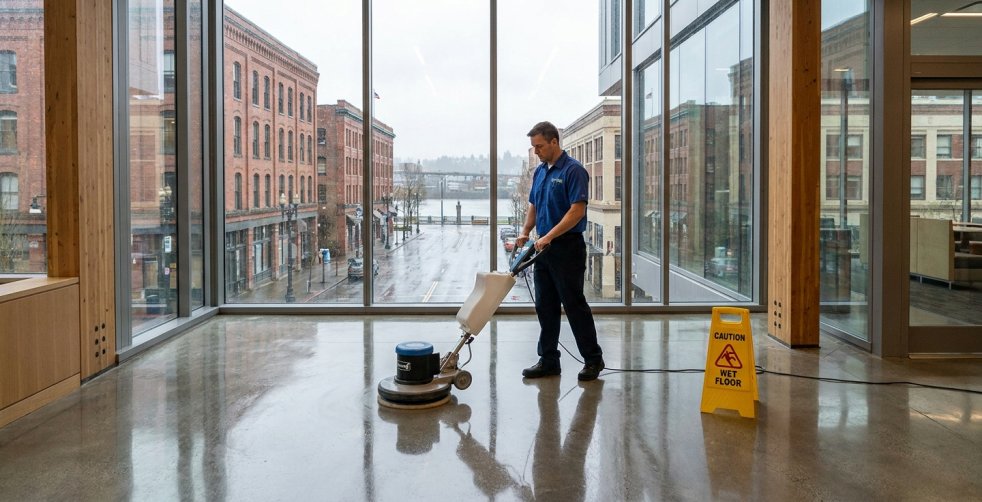
Preventative Maintenance: How Facility Services Reduce Long-Term Costs in Portland
Most facility costs do not show up as a single large bill. They accumulate quietly over months and years, driven by deferred cleaning, inconsistent maintenance, and the specific environmental pressures that Portland commercial properties face across every season.
The businesses that keep those costs under control are not the ones that react fastest when something breaks. They are the ones that prevent the breakdown from happening in the first place.
What Preventative Maintenance Actually Means for a Commercial Facility
Preventative maintenance in a facility context goes well beyond swapping out HVAC filters on a calendar schedule. It means applying consistent, structured care to every surface and system before deterioration takes hold.
For most commercial buildings, the cleaning program is the front line of that effort. Floors, restrooms, common areas, and hard surfaces all degrade faster when routine maintenance is skipped or applied inconsistently.
- Grout and caulking break down when moisture is not removed on a consistent schedule, leading to mold remediation costs that far exceed regular cleaning fees
- Hard floor finishes wear through faster when dirt and grit are not removed frequently, requiring refinishing or full replacement years ahead of schedule
- HVAC systems work harder and fail sooner when dust and particulate accumulate on vents, filters, and surrounding surfaces
- Restroom fixtures corrode faster when cleaning products are misapplied or surfaces are left wet between service visits
Portland Climate Factors That Accelerate Facility Deterioration
Portland averages around 144 rainy days per year, and the sustained moisture that comes with that climate creates conditions that are harder on commercial buildings than most facility managers account for. The mild temperatures that accompany all that rain mean mold and bacteria can thrive year-round, not just in summer.
Beyond the rain, Portland facilities face a distinct set of seasonal pressures that a generic cleaning schedule will not address on its own.
- Heavy rainfall from October through May saturates entryways and lobbies with tracked-in moisture, accelerating floor finish wear and creating persistent slip hazards
- Restrooms and break rooms in Portland buildings develop mold on grout, caulking, and wall surfaces faster than in drier climates, especially in spaces with limited ventilation
- Wildfire smoke from late summer pushes fine particulate through HVAC systems and into shared spaces, increasing the cleaning burden on filters, vents, and all interior surfaces
- Winter freeze and thaw cycles at higher elevations and in exposed parking structures force moisture into floor seams and concrete near building entrances
- Pollen season in the Willamette Valley is intense, and fine particles settle on surfaces, vents, and electronics at a rate that outpaces many standard cleaning schedules
The Real Cost of Deferred Facility Maintenance
Reducing cleaning frequency feels like a cost-saving in the short term. The actual financial impact runs in the opposite direction.
Deferred maintenance compounds. A floor that needed stripping and recoating after two years of inconsistent care costs significantly more to restore than one maintained on a proper schedule. Mold remediation in a neglected restroom can run into thousands of dollars, plus the disruption of closing the space during treatment.
- Hard floor refinishing costs increase sharply when the finish is allowed to wear through to the substrate
- Carpet replacement timelines shorten by years when interim cleaning and spot treatment are skipped
- Mold remediation in commercial spaces typically costs between $1,000 and $10,000, depending on scope, compared to a fraction of that for consistent preventative cleaning
- Pest infestations triggered by food residue and moisture in neglected spaces carry both remediation costs and reputational risk
- Liability exposure increases when slip hazards, sanitation failures, or air quality issues go unaddressed in occupied commercial facilities
Warning Signs Your Facility Maintenance Program Is Falling Behind
These problems develop gradually. By the time they are clearly visible, the cost to correct them is already higher than it needed to be.
- Floor finish that looks dull, scuffed, or uneven in high-traffic zones
- Grout lines in restrooms or break rooms that have darkened or show visible mold growth
- Persistent odors in restrooms or common areas that return quickly after a cleaning visit
- Dust accumulation on vents, baseboards, or ceiling tiles between service visits
- Moisture staining on walls, ceilings, or around windows that has not been investigated or addressed
- Staff or tenant complaints about cleanliness that have become routine rather than occasional
Each of these is a signal that the current program is not keeping pace with what the facility actually needs.
What a Structured Facility Services Program Looks Like
A preventative approach to facility maintenance is built around frequency matched to actual use and seasonal conditions, not a generic schedule applied to every space the same way.
- High-traffic entryways receive floor care on a frequency that accounts for Portland's rainy season, not a once-per-week default
- Restrooms are serviced with products and techniques that address mold risk and moisture, not just visible surface appearance
- Hard floor care includes interim scrubbing and recoating before the finish reaches a point of no return
- Carpet is spot-treated consistently and deep-cleaned on a schedule that extends its useful life
- HVAC vents and surrounding surfaces are included in the cleaning scope during and after wildfire smoke season each year
The goal is to keep every surface and space ahead of the deterioration curve, not to restore it after the damage is already done.
What Portland Businesses Should Do Now
System4 of Oregon provides commercial cleaning and facility maintenance services to businesses throughout the Portland area, with programs built around the regional conditions and building types that define this market.
- Walk through your facility and note any flooring, restroom, or common area issues that have become normalized rather than addressed
- Review whether your current cleaning schedule matches actual occupancy levels and Portland's seasonal demands, including the long wet season and late-summer smoke period
- Assess whether your floor care program includes interim maintenance steps or only addresses surfaces after visible wear has already set in
- Ask whether mold risk in restrooms and moisture-prone areas is being managed proactively
Call (971) 606-5372 today to schedule a facility walkthrough and find out how a structured commercial cleaning program from System4 of Oregon can reduce your long-term facility costs and keep your building performing at a higher standard year-round.


